Blue Flower
Surprised by JoyThe Blue Flower is C. S. Lewis’s name for the longing he says first took hold of him before he was six. Beginning with the distant hills visible from the nursery, the image marks a recurring pattern in his life: art and landscape awaken an intense desire that cannot be satisfied simply by possessing what prompted it. Its significance lies not in one object, but in the way successive encounters with poetry, myth, music, and fiction renew and reshape that desire.
The Hills and the First Longing
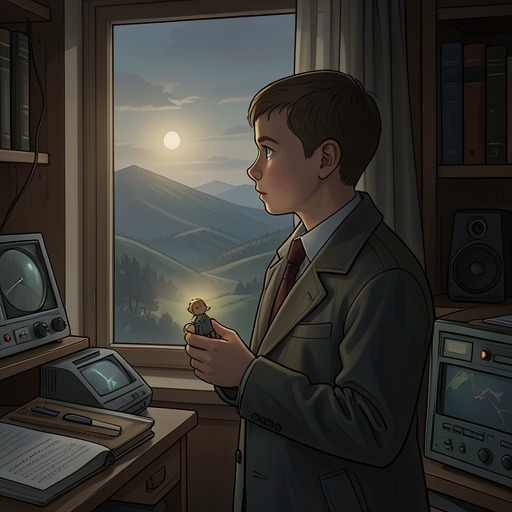
From the nursery windows, the low line of the Castlereagh Hills seemed near yet unattainable to the children. Lewis recalls that they taught him longing, and that before he was six he had become a votary of the Blue Flower. The image thus begins in a particular view of the landscape: distance turns the hills into more than scenery, making them the first occasion for a desire whose object remains out of reach.
The Blue Flower belongs to Lewis’s account of childhood as a period largely lacking in imaginative or religious intensity. He distinguishes its occasional moments of joy from the ordinary happiness of family life. The hills did not make childhood uniformly wondrous; they gave him an early experience of yearning that stood apart from routine contentment. That distinction helps explain why he later treats the Blue Flower not as a pleasant memory but as the beginning of a lasting imaginative disposition.
A Pattern Renewed by Literature
The account of his response to Matthew Arnold’s Sohrab and Rustum shows how such longing could be awakened by art without being reducible to its plot or learned references. As a boy at Campbell College, Lewis was drawn to the poem’s atmosphere of distance, calm, and grave melancholy, and to its particular images: the artist from Pekin, the cypress in the queen’s garden, the pedlars from Khabul, and the Chorasmian waste. He did not yet understand the central tragedy or know Homer; later, he found that the Iliad recalled Sohrab and Rustum. The sequence illustrates how one literary encounter can prepare the way for another, while the Blue Flower itself remains a distinct kind of longing rather than an aesthetic pleasure alone.
At Chartres, an illustrated volume of Siegfried and the Twilight of the Gods abruptly renewed the lost desire. A headline and Arthur Rackham’s illustration gave Lewis his first encounter with Wagner’s world, which he recognized as Northernness: immense, remote spaces under the Northern summer twilight. The image also carried him back to Tegner’s Drapa, Balder, and the sunward-sailing cranes. In that instant, the distant world of the illustration and the recovered memory of his own earlier Joy flowed together. The experience vanished almost as soon as he could recognize it, leaving him with the conviction that recovering it had become his supreme object of desire.
The printed volume first awakened the response before Lewis had heard Wagner’s music. When he later heard a recording of the Ride of the Valkyries at T. Edens Osborne’s shop, its force came to him as heroic drama rather than as a detached concert piece. Wagnerian records, especially from the Ring, became a regular use of his pocket money and a frequent choice for presents. He describes this not as a simple addition to his musical tastes but as a new kind of experience, difficult to call pleasure: trouble, ecstasy, astonishment, and conflicting sensation. The sequence—from illustration to music—shows the longing being intensified through different forms without being resolved.
Reading, Reception, and Transformation
Lewis’s later reading of Homer gives the Blue Flower’s pattern a further turn. Under Kirkpatrick, he and his tutor worked through the Iliad’s Achillean portion and then the whole Odyssey. Lewis’s initial response was romanticized by his reading of William Morris; he called Circe a wise-wife and described marriages as high-tides. He later said that this youthful error had passed, while the wanderings still mattered and Odysseus’s stripping off his rags and bending the bow meant even more. Homer’s value therefore changes with rereading, but the imaginative force of distance and return persists.
The Blue Flower’s course is not simply a search for one lost sensation. In his account of reading George MacDonald’s Phantastes, Lewis describes encountering a familiar world of woodland journeys, ghostly enemies, and good and evil ladies, yet finding it altered by a new quality he came to call holiness. This later experience clarifies how a longing first associated with remote landscapes and imaginative worlds could be redirected by literature. The Blue Flower names the early form of desire; its recurrence across very different works shows how the desire could continue even as the meaning of what drew him changed.
Significance
Across these episodes, the Blue Flower is less a fixed symbol than a thread linking distinct acts of reception. The Castlereagh Hills first taught Lewis to long for what was visible but unreachable; Arnold’s poem gave that longing a literary atmosphere; Rackham’s Wagner illustration abruptly revived it; Wagner’s music deepened it; and Homer and MacDonald later acquired meanings through the order in which Lewis encountered them. Each work stands on its own, but each also changes how the next can be received.
The expression also preserves a crucial distinction in Lewis’s account between pleasure and Joy. The sought-after experience is marked by longing and distance, and its brief return at Chartres is inseparable from its disappearance. The Blue Flower therefore names both an origin and a recurring condition: imaginative encounters promise contact with something beyond the self, but the desire they awaken cannot be converted into a permanent possession.